Money in Czech Republic: Cards and Cash in Prague
The Czech Republic uses the koruna, not the euro. Here is how cards, ATMs and exchange offices work in Prague and how to avoid costly conversion traps.
On this page
The Czech Republic uses the Czech koruna, written Kč and coded CZK, so the euro left over from Austria or Germany will not get you far. Plan on paying by card for most things and carrying a modest amount of koruna cash for the situations that still expect it. That single setup removes most of the money stress from a Prague trip.
The verdict
Pay by card, withdraw koruna from a bank ATM, and skip the exchange windows on the main tourist drags. The koruna has been the country's currency since 1993, so treat any euro price in Prague as a convenience conversion rather than the real price. Lean on cards for the bulk of spending and use cash only where it is genuinely easier.
This approach suits travelers who are comfortable tapping a card and checking a receipt. It works less well for anyone planning to rely on leftover euros or on cash bought at home at a poor rate. If your trip is mostly Prague and a couple of well-known towns, cards and a bank ATM cover almost everything.
What currency the Czech Republic uses
The official currency is the koruna, sometimes called the Czech crown in English and written Kč. Notes run from 100 to 5,000 koruna and coins from 1 to 50 koruna. Prices in Prague are quoted in koruna, so read the number as koruna first and ignore any secondary euro figure.
As an EU member, the Czech Republic is obliged eventually to adopt the euro, but it must meet the entry criteria first, and the online travel guide notes the transition has not happened. That means no dual pricing, no euro ATMs in practice, and no reason to arrive with a wallet full of euros. Convert a small amount or simply use a card from day one.
Is the euro accepted in the Czech Republic?
The euro is not widely accepted, and where a shop or restaurant does take it you will usually get an inferior price. Travelex's currency page is blunt about this: euros may work at some shops, restaurants and hotels, but you may not get the same price as paying in koruna. If a business quotes you in euros, ask for the koruna total and compare before you agree.
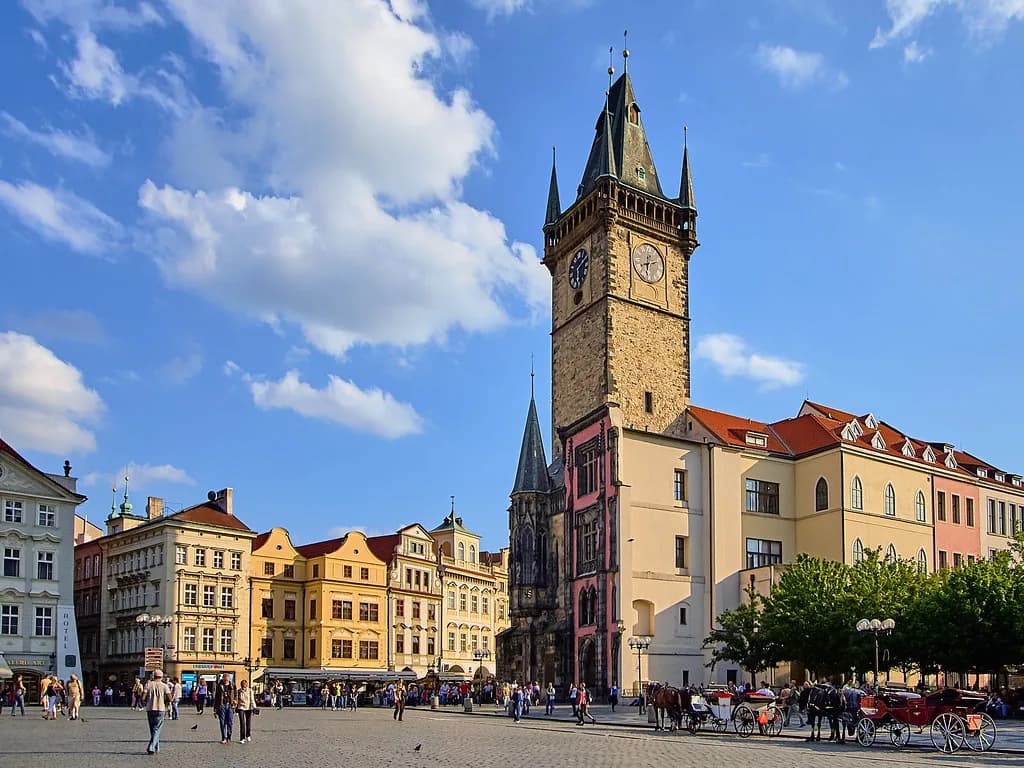
In practice, foreign-exchange kiosks and a handful of heavily touristed businesses near Old Town Square are the places you might see euro prices. Elsewhere, the euro is simply a foreign currency. Treat any acceptance of euros as a favor with a markup rather than a currency option.
Why paying in koruna beats paying in euros
Two conversions can happen on the same purchase, and both cost you. If a card terminal offers to charge you in your home currency, the merchant or its bank sets the rate, and it is almost always worse than letting your own bank convert. Choose koruna on the terminal and let your card issuer do the conversion at its own rate.
The same logic applies at a cash window: the posted euro rate can look close to the mid-market rate while the actual payout is trimmed by commission. Cards normally come out cheaper than cash exchange, with the introducingprague guide putting the typical card conversion cost at around one percent, well below a bureau de change. Carry a card for large payments and use koruna cash for the rest.
Cards in Prague: where they work and where they don't
Visa and Mastercard are accepted almost everywhere in central Prague, and American Express turns up at hotels and larger restaurants more than at small shops. Travelex notes that cards are widespread among hotels, international stores and established restaurants, while cash still dominates in plenty of smaller places. Ask at the till before you order if you are unsure.
Contactless is the norm at cafes, supermarkets and ticket machines, and it is quick enough that you will rarely need cash in the center. The weak spots are small kiosks, market stalls, some taxis and rural pubs. Carry a few hundred koruna in notes and coins so a cash-only counter does not derail your afternoon.
ATMs: the main way to get koruna
Bank ATMs are scattered through Staré Město and Malá Strana, so finding one is not the problem; choosing the right one is. Use a machine attached to a named bank rather than a standalone kiosk in a tourist corridor, and decline any offer to convert the withdrawal into your home currency. Your own bank's foreign-transaction fee is worth checking before you fly, since that is what you will actually pay.
Withdraw a sensible lump sum rather than making many small withdrawals, because fixed fees and any operator charge hit each transaction separately. Keep the receipt until you have counted the notes, and use indoor machines during bank hours if you want staff nearby. If a machine offers a conversion screen, take the koruna option and move on.
Exchange offices: how the posted rates can mislead
A window sign showing an attractive rate often hides a commission or a worse rate for the amount you actually hand over. The introducingprague guide advises asking exactly how many koruna you will receive for a specific amount of euros or dollars before agreeing, and it warns that '0% commission' signs are marketing rather than a guarantee of a good deal. Bureaux de change in the center generally beat hotels and airports, and banks typically charge around two percent.
If you must change cash, do it in a staffed office where you can see the total written down, and count the notes before leaving the counter. Avoid the unmarked kiosks that cluster around the main squares. For most travelers, a bank ATM plus a card is simpler and cheaper than shopping for the best window rate.
Banks, hotels and the airport
Convenience locations charge for the convenience. Hotels and airport exchange desks are usually the most expensive places to change money, according to the introducingprague guide, and bank branches typically work Monday to Friday, 8 am to 5 pm if you need counter service. Arriving with a card and withdrawing at a bank ATM near your accommodation beats changing cash at the airport on arrival.
Bank branches in Prague are plentiful in the center, but do not plan your day around a counter visit. If you need one, go in the morning on a weekday and bring your passport as identification. Otherwise, use an ATM and keep moving.
'0% commission' signs and what they mean
A zero-commission sign tells you nothing about the rate you will get, and the margin is often built into the exchange rate itself. The introducingprague guide is direct on this point, describing such signs as marketing maneuvers to attract clients rather than a sign of a good deal. Compare the amount of koruna you receive, not the commission headline.
A practical test is to ask what a round amount of your own currency buys at two offices a few doors apart, then compare the koruna totals. If the results differ by more than a trivial amount, the rate is doing the work. Walking one street away from the main squares usually improves the offer.
What costs what, described in words
Prague is a mid-priced European capital: a sit-down lunch in a residential neighborhood is modest, a beer is cheap by Western European standards, and a coffee on Old Town Square carries a premium for the view. Groceries, local transport and museum tickets sit in the affordable range, while anything aimed squarely at visitors costs what visitors expect to pay. For a fuller breakdown by category, see whether the Czech Republic is expensive.
Outside Prague, prices drop noticeably, especially in smaller towns where a pub lunch or a regional museum entry costs less than the Prague equivalent. The gap is one reason to spend part of the trip beyond the capital. Budget in koruna rather than converting every line back into dollars or euros, and the numbers become easier to judge.
Day trips and the regions: cash matters more outside Prague
In Prague, card acceptance is close to universal; in smaller Czech towns it thins out quickly. A village pub, a farm stall, a rural bus driver or a small museum may expect koruna, and there is no guarantee a card reader will be working when you arrive. Carry enough cash to cover a meal and a local fare before you leave the city.
This is where your itinerary shapes your cash needs. A trip built around Český Krumlov, South Moravia wine country or a few castle towns means more cash-only moments than a Prague-only week. For a wider list of where to go, see the guide to the best cities in Czech Republic.
If you are still deciding whether the country earns a slot on your trip, the verdict on whether the Czech Republic is worth visiting covers what the cities deliver and where the crowds bite. If you are weighing neighbors in the region, our Hungary verdict applies the same test to Budapest and beyond. If you plan to drive to smaller towns, renting a car in Czech Republic is worth reading before you commit to rural stops.
What to sort before you leave home
Before you fly, check what your bank charges for foreign card use and overseas ATM withdrawals, because those fees decide whether cards or cash are cheaper for you. Decide on one backup card kept separately from the main one, and confirm a PIN you actually remember. That is the whole preparation; everything else can be handled on the ground.
Pack a Type E plug adapter if you are coming from the US or UK, since Czech sockets will not take your home plug. If you need the detail, the guide to Czech Republic plug type covers it. Then read a few practical Czech Republic travel tips on transport tickets and local habits before you land.
Money pitfalls that catch first-time visitors
The most common mistake is arriving with a wallet of euros and assuming they will work. The second is accepting a card terminal's offer to charge you in your home currency, which quietly hands the conversion to the merchant. The third is changing cash at the airport or a hotel desk simply because it is nearby. All three are avoidable with a card, a bank ATM and a little patience.
A fourth is carrying only large notes: some cafes and kiosks dislike breaking a big bill for a coffee, so keep a mix of 100 and 200 koruna notes for everyday spending. Finally, keep the exchange receipts and count your change at the counter, not after you have walked away.
Tipping and small change in Prague
Tipping in Prague is usually done in cash, and the simplest habit is to round up or leave a modest percentage on a restaurant bill. Tell the server the total you want to pay, including the tip, rather than leaving coins on the table, which is less common in Czech restaurants. For the etiquette detail by venue type, read tipping in Czech Republic.
Keep a handful of smaller coins and notes specifically for tips, cloakroom charges and small purchases. This is the main reason to withdraw a little cash even if you pay by card everywhere else. It also saves you from breaking a large note for a small coffee.
Where the money guide fits into your trip
Money is a small part of the Czech Republic decision, but getting it wrong colors everything else. For timing, the best time to visit Czech Republic covers crowds and weather by season, and getting around Czech Republic explains the trains and buses that make regional stops cheap. Read those two together before you book flights.
If your trip includes a second city, the comparison of Brno vs Prague sets out cost and crowd trade-offs, and the guide to the Czech Republic in April covers a quieter shoulder season. Both are useful when you are deciding how long to stay and where to base yourself.
Plan Your Visit
Bring a card that does not punish foreign spending, withdraw koruna from a bank ATM, and keep a modest cash reserve for rural stops and tips. Decline any terminal or window offer to convert for you, and ask for the koruna total whenever a euro price appears. That routine covers Prague, the regions and everything in between.
For the wider trip, start with the country verdict, then pin down your season and your route. Entry rules and passport requirements sit with your own government's official travel page for the Czech Republic, and visa questions should go there once. With the money question settled, the rest of the planning gets a lot simpler.
Frequently Asked Questions
Can I use the euro in the Czech Republic?
Only occasionally. The koruna is the legal currency, and while some shops, restaurants and hotels in tourist-heavy Prague may take euros, you will usually pay more than you would in koruna. Ask for the koruna total whenever a euro price is quoted.
Should I pay by card or cash in Prague?
Card for most things. Visa and Mastercard work almost everywhere in central Prague, including cafes, supermarkets and ticket machines. Keep a few hundred koruna on you for small kiosks, market stalls, some taxis and pubs outside the city, where cash still carries the day.
Where should I get koruna?
A bank ATM is the simplest route: withdraw a sensible lump sum, decline any offer to convert the withdrawal into your home currency, and let your own bank handle the rate. Exchanging at home, at the airport or at a hotel desk generally costs more.
Do ATMs in Prague charge fees?
Bank-operated machines are the safer choice, and your own bank's foreign-transaction and withdrawal fees usually matter more than the machine itself. Avoid standalone kiosk ATMs in tourist corridors and always take the koruna option on any conversion screen.
Is it cheaper to exchange money in Prague or at home?
Usually in Prague, but only at a staffed office where you can see the total. Ask exactly how many koruna a set amount of your currency buys and compare two offices before committing, since posted rates and commissions can hide the real cost.
Why do exchange offices advertise 0% commission?
Because the margin sits in the rate rather than the commission line. The sign tells you nothing about what you actually receive, so compare the koruna totals for the same amount at two windows a few doors apart.
How should I tip in Prague?
Round up or add a modest percentage and tell the server the total you want to pay, including the tip. Keep small coins and notes for tips, cloakroom charges and little purchases, which is the main reason to carry some cash even if you tap a card everywhere else.
Sources
Trip-decision notes
Optional updates when we publish or revise a destination verdict.
You might also like

Continue reading
More guides you'll find useful