Money in Bosnia: Currency, Cards, Cash and Tipping Explained
Bosnia and Herzegovina uses the convertible mark, pegged to the euro. Here is how cards, cash, ATMs and tipping actually work on a Bosnian trip.
On this page
You will spend convertible marks in Bosnia and Herzegovina, not euros, and you should plan on carrying some cash even if you pay for hotels and bigger meals by card. The mark is fixed to the euro at a rate that has not moved in decades, which makes budgeting unusually simple for a non-euro country.
What follows sorts the country into card territory and cash territory by place type, explains the two money mistakes that actually cost visitors, and gives practical figures for daily cash and tipping. It is written for people deciding how to fund a trip, not for currency traders, so the useful parts are the habits rather than the exchange-rate theory.
The verdict: convertible marks, some cash, no euro-only assumption
Treat the convertible mark as the only money you can rely on and euros as a convenience you occasionally get away with in tourist areas. Cards handle hotels, supermarkets, car rental and mid-range restaurants in Sarajevo, Mostar and Banja Luka; cash handles markets, small bakeries, rural guesthouses and taxis.
The practical setup is a card for the big bills and roughly 40 to 80 KM in notes for a normal day of coffee, snacks, a taxi and tips. That figure comes from traveler-facing money guidance rather than an official statistic, so treat it as a starting point and raise it if you are heading into the countryside or shopping at markets.
If money discipline is the thing that decides whether a Balkan trip fits your budget, the wider question of value is worth settling while you plan. Our take on whether Bosnia is worth visiting covers what the country delivers for the cost, and our guide to whether Bosnia is cheap breaks down real daily spending by category. Check current prices before you commit to dates.
What currency Bosnia and Herzegovina uses
The official currency is the convertible mark, written as KM in shops and BAM in banking systems, and divided into 100 feninga. Banknotes come in 10, 20, 50, 100 and 200 KM, with coins for the feninga and for 1, 2 and 5 KM, so a withdrawal in round notes will cover most small purchases without hunting for change.
The currency was introduced in 1998 and was first tied to the German mark before being pegged to the euro in 2002. That history explains why the local name still carries the word convertible: the point of the design was a stable, exchangeable currency after years of monetary chaos.
You will see both labels in daily life, KM on price tags and menus, BAM on card statements and ATMs. Neither is a different currency, so do not let a receipt showing BAM make you think you have been charged in something else.
The euro peg and what it means for your budget
The mark is fixed at 1 EUR = 1.95583 BAM, a rate it has held since the late 1990s. For mental arithmetic, call 2 KM roughly 1 EUR and you will never be far off, though the true rate is slightly kinder to the euro than that.
Because the peg is fixed, your euro-to-mark sums do not drift between booking and arrival, which is unusual in the Balkans and makes Bosnia one of the easier countries to budget. What does move is your own currency against the euro, so the number that matters most for a US or UK traveler is the euro rate, not the mark.
Use a live converter for your home currency on the day you travel rather than memorizing a dollar or pound figure now. The mark-to-dollar and mark-to-pound rates shift with the euro, and no published number stays accurate for long enough to plan around.
Can you pay in euros in Bosnia and Herzegovina?
Euros turn up as an accepted payment in larger hotels, some restaurants and busy tourist areas, usually rounded to about 2 KM per euro. Your change will normally come back in marks, so paying in euros is a convenience rather than a strategy, and the rounding quietly costs you a little each time.
Do not build a trip on the assumption that euros work everywhere. In Mostar's old town and central Sarajevo you may get away with it; at a rural guesthouse, a village bakery or a market stall you will be asked for marks, and in a taxi you may simply be refused.
The sensible habit is to exchange or withdraw marks early in the trip and keep euros for the border crossing into Croatia or Montenegro, where they are the local currency. If you are still weighing which parts of the country justify the miles, the best places to visit in Bosnia is a good way to sequence a route around Sarajevo, Mostar and the national parks. Whether the neighbours deliver similar value is a fair question too, so weigh is Montenegro worth visiting while you plan the next leg.
Cards and contactless: where they work and where they do not
Visa and Mastercard work reliably at larger hotels, car rental desks, supermarkets and mid-range restaurants in Sarajevo, Mostar and Banja Luka, and contactless terminals are increasingly common in modern shops and chain cafés. Smaller bakeries, street food stalls, market vendors and countryside accommodation are another matter and are often cash-only.
Keep 20 to 50 KM in small notes for the day-to-day gaps: a coffee in a backstreet café, a burek, a short taxi ride or a tip. Breaking a 100 KM note at a market stall is awkward for everyone, so ask for smaller notes when you withdraw.
Do not expect international super-app wallets to be part of everyday life the way they are in parts of Asia. Locals increasingly use mobile wallets tied to local banks, but a foreign visitor should plan on a physical card plus cash rather than a phone-based wallet.
ATMs and exchange offices: how to get the best rate
Bank ATMs in cities and larger towns are the simplest way to get marks, and they generally track the official rate closely. Withdraw larger amounts less often to limit the fixed fees your home bank charges per transaction.
Licensed exchange offices, known locally as mjenjačnica, and banks in Sarajevo and Mostar usually beat airport counters and hotel desks, which add commissions or poor spreads on the fixed euro peg. If you arrive with euros in hand, change a modest amount at the airport and do the rest in town.
Arriving by air into Sarajevo or Tuzla and heading straight out to the mountains usually means you need wheels, and fuel, tolls and parking are all cash-or-card decisions worth planning. Our guide to renting a car in Bosnia covers the paperwork and the road rules, which matters more to your budget than a fraction on the exchange rate.
Dynamic currency conversion and other easy money mistakes
The most common cost is not fraud but a bad rate, and the biggest culprit is dynamic currency conversion. When an ATM or card terminal offers to charge you in your home currency, decline and choose marks; the conversion mark-up is typically several percent on top of the real rate.
The second mistake is changing money at airport kiosks, border booths or hotel desks out of convenience. Because the peg is fixed, you can spot a poor offer quickly: anything well below about 1.93 KM per euro is worth walking away from.
A third, quieter one is taxi pricing in tourist areas, where a driver may quote a flat sum instead of using the meter. Agree the fare in marks before you get in, and treat quotes far above a normal short ride as a signal to find another car.
How much cash to carry, and in what denominations
For a typical day of coffee, lunch, a couple of taxis and small tips, 40 to 80 KM covers most travelers comfortably, with cards picking up hotels and larger dinners. Raise that if you are heading to rural areas, markets or guesthouses where cards are rare.
Carry a mix rather than a single large note: 10s and 20s are the useful denominations for cafés, bakeries and taxis, with a 50 kept in reserve. Spread cash between a wallet and a bag so a lost note does not end the day.
At the end of a trip, spend or exchange leftover marks before you leave the region. The currency is not widely traded outside Europe, so finding an exchange that accepts it once you are home can be a nuisance.
Tipping in Bosnia and Herzegovina: restaurants, cafés, taxis
Tipping is appreciated but low-key, and there is no strict expectation. In restaurants, adding 5 to 10 percent for attentive service is the local habit; in cafés and bars, rounding up to the next mark is enough.
For taxis, round the fare up rather than calculating a percentage, and hand over the note with the total stated so there is no confusion about change. Hotel staff who help with bags might get a couple of marks, though it is not required.
Because the amounts are small, tipping will not reshape your budget, and paying by card makes it awkward to leave cash unless you say the amount you want added. Keeping a few 5 KM notes aside solves that.
What things cost: food, coffee, transport
Prices are moderate by Western European standards, and the peg keeps them stable. A sit-down meal at a local restaurant typically runs 15 to 25 KM per person, a coffee in a city café 2 to 4 KM, and a hearty burek from a bakery 8 to 12 KM, which makes eating well here cheaper than in Croatia or Italy.
Short city taxi rides usually land in the 5 to 10 KM range depending on distance, and public transport between cities is cheaper than private transfers. Use those figures as a sanity check when a quote comes in far higher.
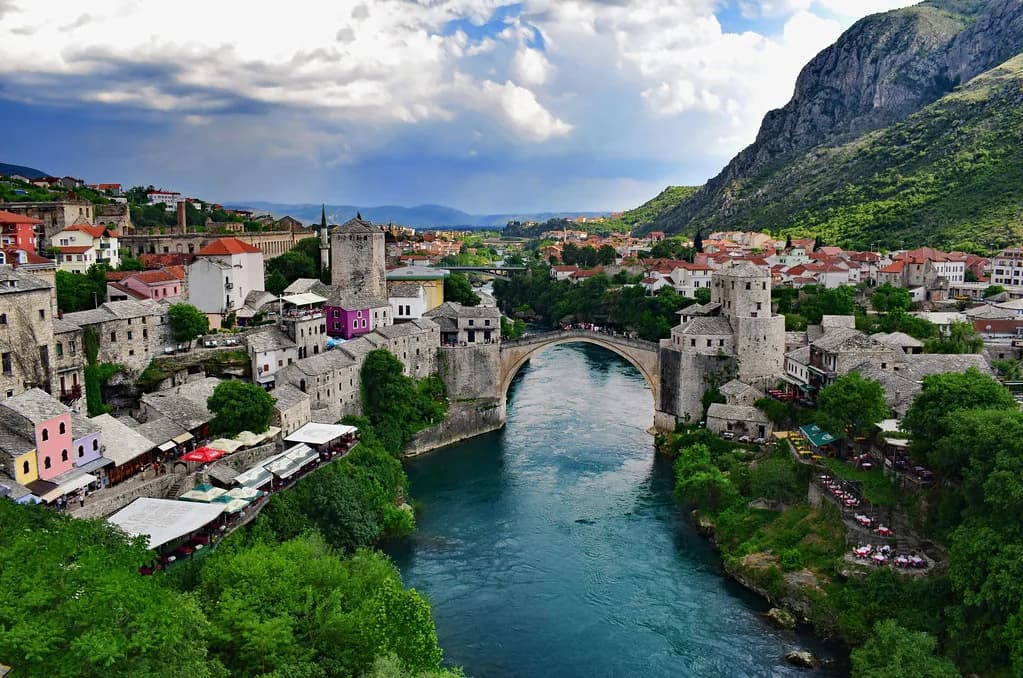
Season changes the picture more than inflation does, since summer crowds in Mostar push up prices near Stari Most while spring and autumn keep them calmer. Our guide to Bosnia in May and to Bosnia in October show what those shoulder months look like for both weather and crowds.
Money limits: large cash transactions
Cash transactions above 15,000 BAM require extra documentation under anti-money-laundering rules, a threshold well beyond anything a normal holiday spends. It matters only if you are paying for something substantial in cash, such as a large purchase or a long private rental.
For ordinary travel the rule changes nothing, but it is a reminder that large cash payments invite paperwork. Use a card or a bank transfer for anything big and keep cash for the small stuff it is good at.
Sending leftover marks home
Marks are hard to exchange outside Europe, so the cheapest approach is to spend them down or convert them at a bank before departure rather than carry them home. Airport counters at the end of a trip tend to offer the weakest rates of the whole journey.
If you leave with a small amount, treat it as a souvenir of the next trip rather than a loss, especially if you plan to return to the Balkans. Remaining euros are far more useful, since Croatia and Montenegro both use them.
Money in Bosnia and Herzegovina: questions travelers ask
The questions that come up most are about the currency itself, whether euros work, and how much cash to carry. The short answers sit below, with the practical detail in the sections above.
Plan Your Visit
Fund a Bosnia and Herzegovina trip with a card for the big items and a few dozen marks in your pocket for everything small, and the money side of the trip stops being a worry. Keep euros for the countries next door, decline conversion to your home currency at terminals, and round up rather than calculate when you tip.
Once the currency is settled, the remaining decisions are timing and route: the best time to visit Bosnia covers weather and crowds month by month, and a rental car opens up the landscapes beyond Sarajevo and Mostar. Sort those two and the budget follows.
Explore more Bosnia and Herzegovina trip-decision guides
Frequently Asked Questions
Does Bosnia and Herzegovina use the euro?
No. The official currency is the convertible mark, written KM locally and BAM internationally. Its value is fixed to the euro, so prices stay stable and easy to convert, but you still pay in marks.
Can I use euros in Bosnia and Herzegovina?
Euros are sometimes accepted in larger hotels, some restaurants and busy tourist areas, usually rounded to about 2 KM per euro, and your change comes back in marks. Do not count on them at markets, rural guesthouses, small bakeries or in taxis.
Do credit cards work in Bosnia?
Visa and Mastercard work at larger hotels, car rental desks, supermarkets and mid-range restaurants in Sarajevo, Mostar and Banja Luka, and contactless is common in modern shops. Markets, small cafés, rural accommodation and taxis often take cash only.
How much cash should I carry in Bosnia?
A practical daily float is 40 to 80 KM for coffee, snacks, a taxi and tips, with cards covering hotels and bigger meals. Carry a mix of 10 and 20 KM notes and raise the amount if you are heading into the countryside.
Is it better to use ATMs or exchange offices in Bosnia?
Bank ATMs in cities and larger towns are simple and generally track the official rate, and licensed exchange offices usually beat airport counters and hotel desks. Change a small amount on arrival and do the rest in town.
How much should you tip in Bosnia and Herzegovina?
In restaurants, 5 to 10 percent for good service is the local habit, and in cafés and bars rounding up to the next mark is enough. For taxis, round the fare up rather than calculating a percentage.
Sources
Trip-decision notes
Optional updates when we publish or revise a destination verdict.
You might also like
Continue reading
More guides you'll find useful