Is Bosnia Worth Visiting? A Candid Verdict for 2026
Yes, Bosnia and Herzegovina is worth visiting for Mostar, Sarajevo, Ottoman old towns and wild mountains. Here is who it suits, who should skip it, and when to go.
On this page
Yes, Bosnia and Herzegovina is worth visiting, provided you want history, mountains and Ottoman-era towns rather than a beach holiday. Sarajevo packs a bazaar, Austro-Hungarian streets and siege history into one walkable valley, Mostar delivers the Stari Most and its old town, and Sutjeska National Park offers some of the wildest terrain in the Balkans. Travelers who want a resort, a pool and a coastline should look at Croatia or Montenegro instead.
The country is compact but not quick: buses link the main cities reliably, rail is limited, and the rewarding places in Herzegovina and the mountains are easiest with your own wheels. Budget travelers will find it gentler on the wallet than the Adriatic coast, though cash still matters outside the cities. The rest of this guide gives the evidence, the drawbacks and a verdict by traveler type.
The verdict: who Bosnia suits and who should go elsewhere
Bosnia and Herzegovina suits travelers who measure a trip in old bazaars, stone bridges, mountain trails and recent history. It suits independent travelers willing to ride buses or drive narrow roads, and it suits walkers who want empty trails in the Dinaric Alps. It does not suit travelers whose main requirement is a beach, a resort or a short transfer from an airport.
The country has very little coastline, so summer heat is something you endure rather than escape by swimming. That is a fair trade if you care more about the Baščaršija bazaar in Sarajevo or the Neretva River running under Mostar's bridge than about sunbathing. If you want both culture and sea, split the trip with Croatia or Montenegro.
First-time visitors should treat Sarajevo and Mostar as the two anchors and add Herzegovina's day-trip circuit from Mostar. Travelers with more time can push into the mountains around Sutjeska or north to Jajce and Banja Luka. Our picks for the best places to visit in Bosnia assume roughly a week, which is enough for the highlights without rushing.
What makes Bosnia worth the trip
Bosnia's strength is density of contrast: Ottoman mosques, Austro-Hungarian facades, Orthodox cathedrals and communist-era blocks often within a few streets of each other. Sarajevo is the clearest example, but Mostar, Banja Luka and Jajce all show overlapping layers of empire and nation. Add mountains, rivers and waterfalls within day-trip range and you have a country that rewards curiosity more than relaxation.
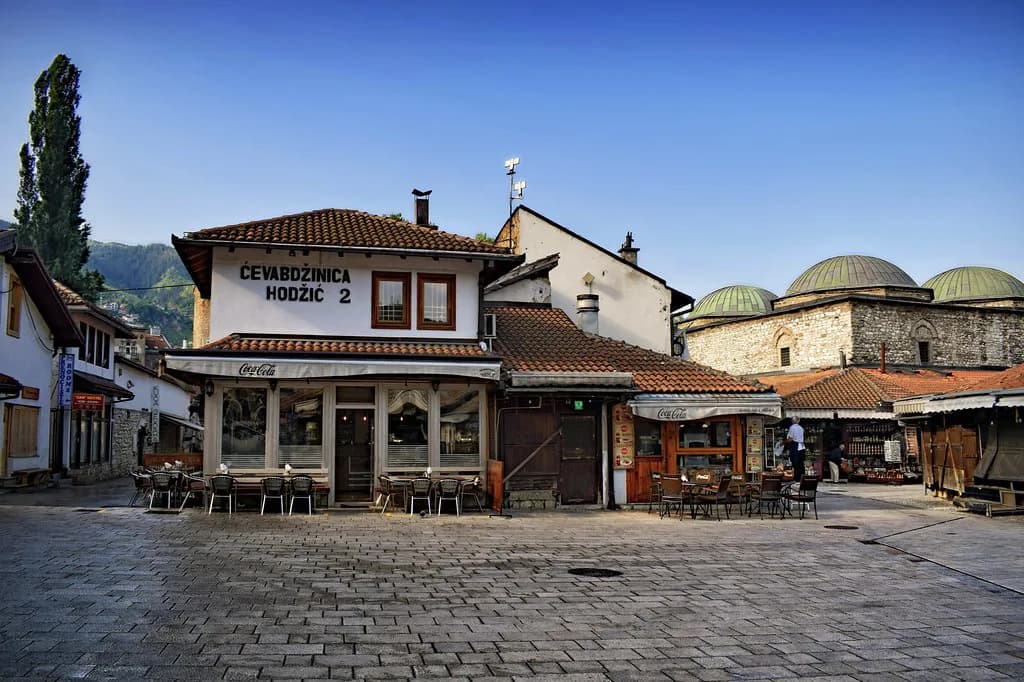
The food is a reason in itself: ćevapi in somun bread, burek from a bakery, Bosnian coffee served in a džezva. None of it is precious or expensive in the cities, and family-run restaurants in smaller towns often outperform smarter places. Travelers who plan around meals will find Bosnia generous.
Sarajevo: Ottoman bazaar, Austro-Hungarian streets and siege history
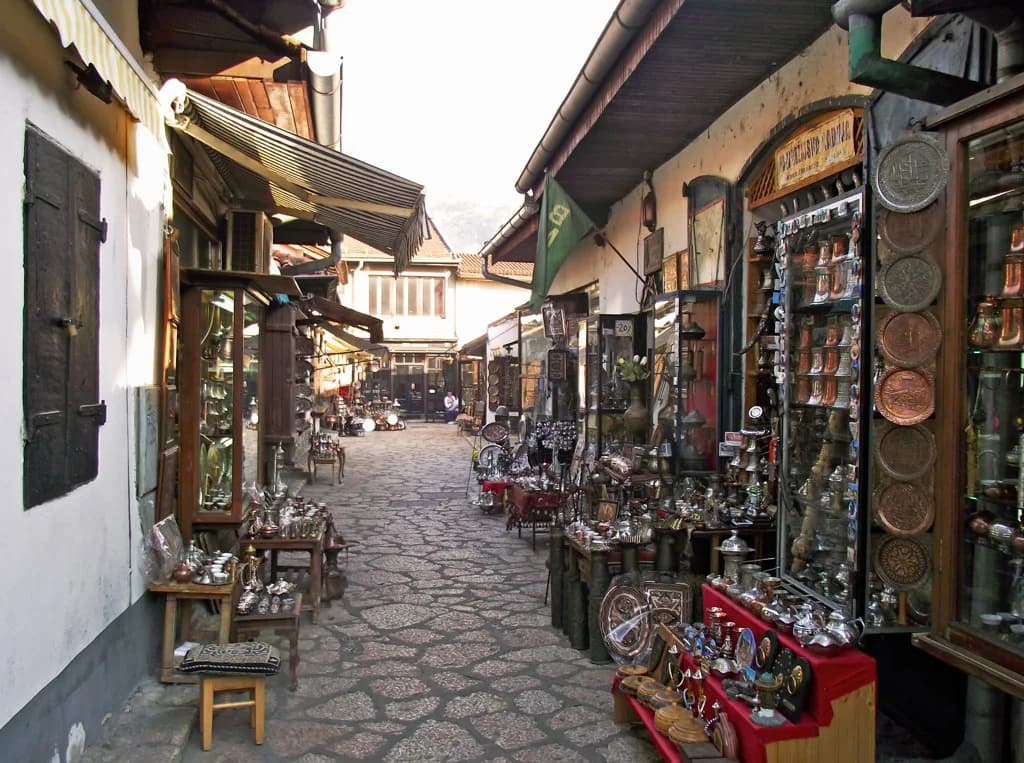
Sarajevo is the country's cultural and historical heart, set in a valley ringed by the Dinaric Alps. The old bazaar, Baščaršija, is a maze of cobbled lanes, copper workshops and the wooden Sebilj fountain at its center. Nearby stand the 16th-century Gazi Husrev-beg Mosque and its clock tower, while the Sacred Heart Cathedral marks the Catholic side of the city's religious mix.
History lovers should walk to the Latin Bridge area, where Archduke Franz Ferdinand was assassinated in 1914, and then visit the Sarajevo War Tunnel, the lifeline that connected the besieged city to the outside world during the 1990s. For views, climb to the Yellow Fortress or take the lift up the Avaz Twist Tower. Two full days is a reasonable minimum; three lets you slow down.
Sarajevo sits among mountains, so weather can change quickly even in summer; a jacket belongs in your day bag. The city is also where bus and rail connections fan out, making it the natural first or last stop on any Bosnia itinerary. If you are building a route, plan Sarajevo and Mostar first and fill in the rest around them.
Mostar and the Stari Most
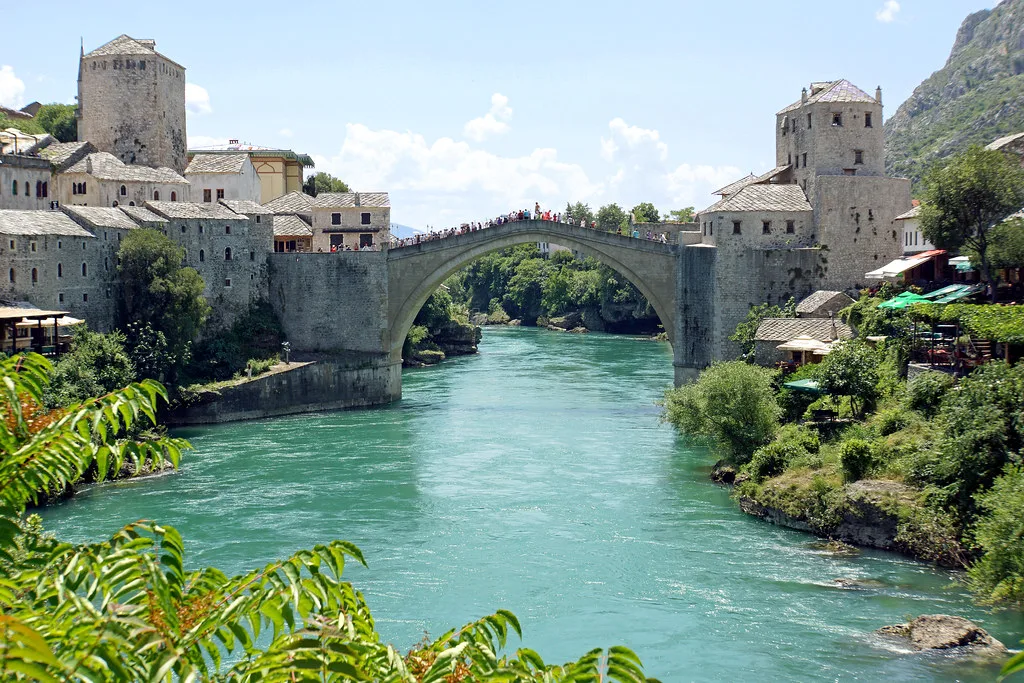
Mostar's Stari Most, a 16th-century arched bridge rebuilt after the 1990s war, is a UNESCO World Heritage Site and the country's signature image. The old town around it is a warren of cobbled lanes, Ottoman houses and bazaars. Divers still leap from the bridge into the Neretva, a drop reported at around 24 meters, though they jump for money rather than on a fixed schedule.
The Koski Mehmed Pasha Mosque minaret gives the classic view over the bridge and river, and the Karadozbeg Mosque is another significant Ottoman site. Beyond the old town, street art covers buildings scarred in the war, and an annual festival adds new murals. Mostar is also the base for Herzegovina's day trips, which is why most travelers give it two nights rather than one.
The trade-off is crowds: Mostar fills with day-trippers from the Croatian coast in summer, and the old town is at its worst in the middle of the day. Staying overnight and walking early or late changes the experience completely. If you are weighing how many days to give Mostar and Sarajevo, our Bosnia itinerary sketches the balance.
The Herzegovina day-trip circuit: Blagaj, Počitelj and Kravica Waterfalls
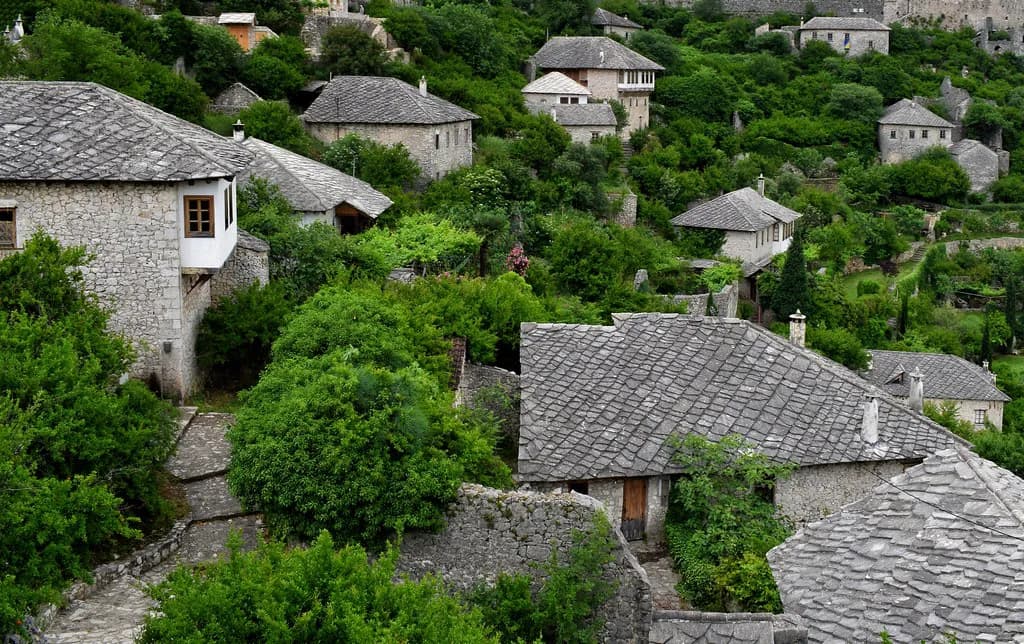
From Mostar you can string together three very different stops in a day. Blagaj Tekke, a 16th-century Sufi dervish house, sits at the foot of a cliff where the Buna River bursts from a cave; the view from across the river is the one to seek. Počitelj is a hillside village of stone houses and stairs, with a restored lookout tower and citadel; the climb is short but steep and punishing in summer heat.
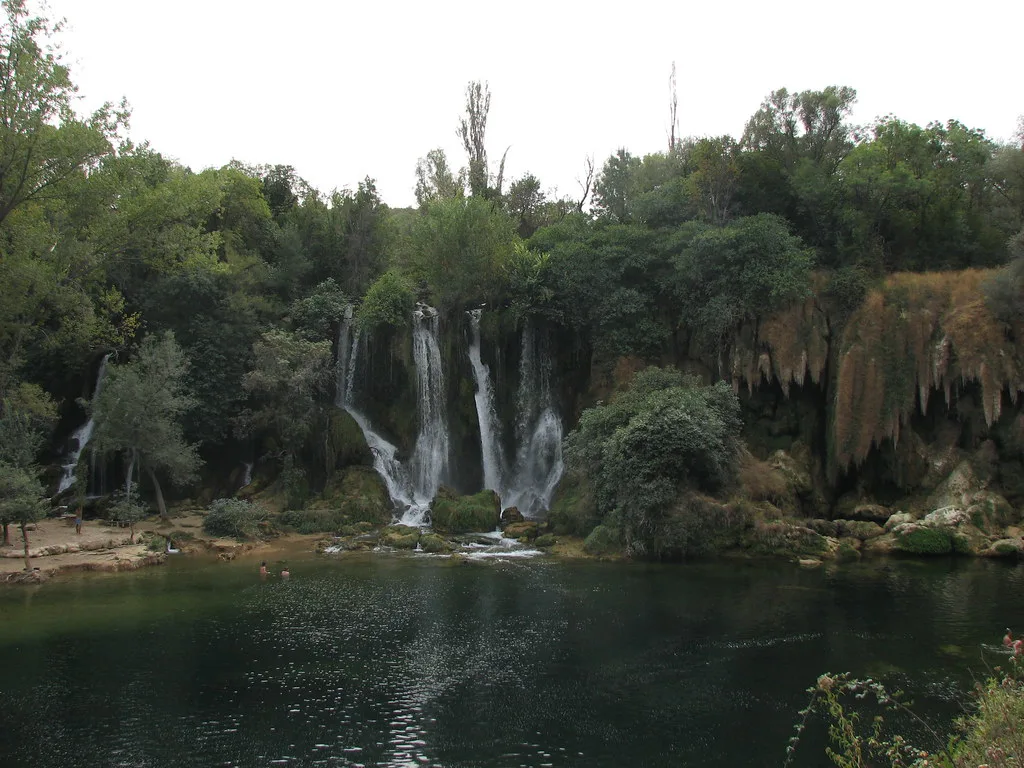
Kravica Waterfalls, near Ljubuški, fan across roughly 120 meters and drop more than 25 meters, with picnic areas, trails and swimming spots. In summer it is a popular swimming and kayaking stop; by autumn the water is cold. The falls are an easy add-on for anyone driving between Mostar and the Croatian border.
Međugorje, the pilgrimage town that draws close to a million visitors a year, is nearby and worth a stop only if the religious context interests you. For everyone else it is mainly a convenient base between the falls and Mostar. Covering all four in one day is possible by car but rushed; two half-days are better.
Jajce, Banja Luka and the north
Jajce is one of the few towns in the world with a waterfall in its center: the Pliva drops more than 20 meters right where the river meets the Vrbas. Above it stand the 13th-century fortress and the underground catacombs carved in the 14th century. Just outside town, the Pliva Lakes and their traditional watermills make an easy half-day.
Banja Luka, the second-largest city, is a different flavor: the 16th-century Ferhadija Mosque and the Christ the Savior Cathedral anchor a lively riverside center, and the old castle holds a restaurant serving ćevapi. It is a working city rather than a showpiece, which is exactly why some travelers like it. Both towns fit naturally on a northbound route between Sarajevo and Croatia.
Bosnia's cities divide between Ottoman-colored Sarajevo and Mostar, Austro-Hungarian-influenced Banja Luka and smaller places like Jajce and Počitelj. If you are choosing where to base yourself, our guide to the best cities in Bosnia compares them by size and character.
Sutjeska National Park and the mountains
Sutjeska National Park, in the southeast, is the country's oldest national park and protects the Perućica primeval forest, one of Europe's last. Mount Maglić, at over 2,300 meters, is the highest peak in Bosnia and Herzegovina; the climb is a serious hike, not a stroll. The park also holds the Sutjeska battle monument, a reminder of the WWII partisan fighting in these valleys.
This is where Bosnia rewards travelers who come for wilderness rather than cities: the trails are quiet, the valleys are steep, and the infrastructure is basic. Bring layers, check conditions with the park, and stay on marked paths. The rewards are empty ridges that rival anything in the region.
If you are timing a mountain trip, the best time to visit Bosnia for hiking is late spring through early autumn, when the snow has gone and the heat is manageable. Bosnia in May and Bosnia in June are strong months for lower trails and waterfalls, while Bosnia in October brings autumn color and quieter paths.
Drawbacks: crowds, heat, transport and infrastructure
The honest drawbacks start with summer: July and August are hot, especially in Herzegovina, and the country has little coast to escape to. Mostar and Počitelj become crowded and physically demanding in the heat, with stairs and cobbles that punish anyone not used to walking. Spring and autumn are cooler and quieter, and prices soften outside high season.
Transport is the second limitation. Buses connect the main cities reliably, but rail service is limited and mountain roads are slow. A rental car opens up Herzegovina's day-trip circuit and Sutjeska, but you need to check insurance coverage for non-EU countries before you go; our guide to renting a car in Bosnia covers the paperwork. Some remote rural areas still carry landmine warnings, so stick to marked paths and local guidance.
Infrastructure is the third: outside the cities, cash is king, English thins out, and small shops still close for an afternoon break in summer. None of this is a reason to skip Bosnia, but it is a reason to plan transport and cash before you arrive rather than improvising.
Weather by month and the best time to visit
Bosnia's climate is continental, with hot summers and cold, snowy winters, plus a Mediterranean influence near Mostar. The chart below shows typical conditions, not forecasts: January averages around -6°C to 1°C (21-34°F), July and August around 11°C to 24°C (52-75°F), and October around 4°C to 15°C (39-59°F). Rain is fairly even across the year, with spring and late autumn the wettest.
The best months for hiking and sightseeing are May, June and September, when the heat fades and the trails are at their best. February and March suit winter activities, with more sunshine than midwinter and longer days. Winter can bring snow for up to six months in the mountains, so check conditions if you plan to drive high roads.
Sarajevo sits among mountains and can serve up four seasons in one day, so pack layers even in summer. If you are deciding between spring and autumn, our best time to visit Bosnia guide breaks down the trade-offs month by month. Travelers going in April should expect changeable weather and fewer crowds.
How many days you need
A week is the sweet spot for Bosnia and Herzegovina: two nights in Sarajevo, two in Mostar with a day for Blagaj, Počitelj and Kravica, and the rest for either Jajce and Banja Luka or a mountain leg. Five days covers Sarajevo, Mostar and Herzegovina without much slack. Ten days lets you add Sutjeska and the north without long drives.
If you have only a long weekend, pick one anchor. Sarajevo alone can fill three days, and Mostar plus the day-trip circuit fills two comfortably. Trying to do both in 48 hours means spending much of it on buses.
Typical costs and money
Bosnia uses the convertible mark, known locally as the KM, fixed at roughly 1 euro to 2 BAM. Euros are widely accepted in tourist areas, but cash in BAM is what you need in rural markets, small restaurants and guesthouses. Cards work in city hotels and restaurants, less so outside them.
Day-to-day costs sit below Croatia's and Montenegro's coastal prices: coffee, bakery food and bus tickets are modest, while mountain huts and park entry are cheap. We do not quote exact prices because they shift; plan on the lower end for the region and carry more cash than you think you need. For a breakdown by category, see is Bosnia cheap.
Tipping is modest: rounding up or leaving around ten percent in restaurants is the norm, and small change is appreciated in taxis. ATMs are available in major towns, so withdraw there rather than relying on exchange offices in villages.
Getting there and getting around
Most travelers arrive by air into Sarajevo, or overland from Croatia's Dalmatian coast via Mostar. Buses connect all major cities and are affordable and reliable; the Sarajevo-Mostar route is the busiest. Rail is limited, though some scenic routes exist. Driving is the most flexible option for Herzegovina and the mountains, but roads are slow and mountain passes need respect in winter.
For phone connectivity, Bosnia sits outside the EU roaming area, so a local SIM or eSIM is the sensible move; the Western Balkans regional zone can carry over between countries. Our Bosnia eSIM guide explains the options. Plug sockets are European Type C and F at 230V, so bring a standard European adapter.
Bosnia vs Croatia and Montenegro: the trade-offs
Croatia delivers the Adriatic: island ferries, pebble beaches, Venetian ports and a mature tourist machine, at a price and with crowds to match. Montenegro compresses a dramatic coast, the Bay of Kotor and rugged mountains into a small area, again with summer crowds on the coast. Bosnia offers Ottoman and Austro-Hungarian cities, war history, wild mountains and lower prices, but no beach culture worth the name.
Choose Croatia for a beach-led family trip or island hopping; choose Montenegro for a short coast-and-mountain break; choose Bosnia for Sarajevo, Mostar and the Dinaric Alps. Many travelers combine two or three, and Bosnia works well as the inland leg of a Dalmatian coast trip. If the coast-and-mountain option tempts you, our Montenegro verdict weighs the same trade-offs one border away.
Verdict by traveler type
History and culture travelers: go. Sarajevo and Mostar alone justify the trip, and Jajce and Banja Luka add depth. Hikers and nature lovers: go in late spring or early autumn for Sutjeska and the Dinaric Alps, and bring proper gear. Budget travelers: go, since Bosnia undercuts the Adriatic coast on food, transport and lodging.
Beach and resort seekers: skip Bosnia, or pair a short Mostar stay with Croatia. Families with young children: pick Sarajevo and Mostar rather than hillside villages, and avoid midsummer heat. Travelers with limited mobility: the old towns are cobbled and stepped, so plan around the flatter riverside areas.
Plan Your Visit
Bosnia and Herzegovina is worth visiting if you want layered history, Ottoman towns, recent war memory and empty mountains, and you are willing to trade beach time and polish for character and lower prices. Base yourself in Sarajevo and Mostar, add the Herzegovina day trips, and use buses or a rental car to reach the rest.
Go in May, June or September for the best balance of weather and crowds, carry cash in BAM, and accept that some roads and trails are slow. Travelers who want a resort should head for the Croatian coast; everyone else will find Bosnia rewards the effort.
Explore more Bosnia and Herzegovina trip-decision guides
- Bosnia in October
- Money in Bosnia and Herzegovina
- Renting a Car in Bosnia and Herzegovina
- Best Places to Visit in Bosnia and Herzegovina
- Best Time to Visit Bosnia and Herzegovina
- Bosnia eSIM
- Bosnia in April
- Bosnia in August
- Bosnia in June
- Bosnia in May
- Bosnia in September
- Bosnia Itinerary
- Bosnia Plug Type
- Is Bosnia Cheap? Real Daily Costs for a Bosnia and Herzegovina Trip
- The Best Cities in Bosnia and Herzegovina
- Bosnia in July
- Do They Speak English in Bosnia and Herzegovina?
- Getting Around Bosnia and Herzegovina
- Mostar vs Sarajevo
- Tipping in Bosnia and Herzegovina
Frequently Asked Questions
Is Bosnia worth visiting?
Yes, for travelers who want history, Ottoman cities, mountains and lower prices than the Adriatic coast. Sarajevo and Mostar are the anchors, with Herzegovina's waterfalls and villages as day trips. It is not a beach destination, so resort seekers should look at Croatia or Montenegro.
Is Bosnia a nice country to travel?
It is rewarding and varied: Ottoman bazaars, Austro-Hungarian streets, war memorials, rivers and mountains within a few hours of each other. The trade-offs are summer heat, busy old towns and slow transport outside the main cities. Travelers who plan around those limits find it one of the most interesting corners of the Balkans.
What are the best places to visit in Bosnia and Herzegovina?
Sarajevo's Baščaršija and war tunnel, Mostar's Stari Most and old town, and the Herzegovina circuit of Blagaj, Počitelj and Kravica Waterfalls are the core. Add Jajce and its waterfall, Banja Luka's Ferhadija Mosque, and Sutjeska National Park for mountains. A week covers the highlights without rushing.
How many days do you need in Bosnia?
Five days covers Sarajevo, Mostar and the Herzegovina day trips. A week adds Jajce and Banja Luka or a first taste of the mountains, while ten days lets you include Sutjeska without long drives. A long weekend should focus on one anchor city.
When is the best time to visit Bosnia?
May, June and September offer the best balance of mild weather, open trails and manageable crowds. February and March suit winter activities with more sunshine than midwinter. July and August are hot and busy, especially in Herzegovina, and mountain weather can change quickly in any season.
Is Mostar worth visiting?
Yes, for the Stari Most, the Ottoman old town and the mosque minarets with river views. It is also the natural base for Blagaj, Počitelj and Kravica. The catch is summer day-tripper crowds; staying overnight and walking early or late makes a real difference.
Is Bosnia expensive?
Bosnia is generally cheaper than the Croatian and Montenegrin coasts for food, transport and simple lodging. The currency is the convertible mark, and euros are accepted in tourist areas, but cash matters outside the cities. For current prices, check menus, bus operators and guesthouse rates directly.
How do you get around Bosnia?
Buses link the main cities reliably and are the default for Sarajevo and Mostar. Rail is limited, and a rental car is the most flexible way to reach Herzegovina's day-trip circuit and Sutjeska. Mountain roads are slow, so allow more time than the distance suggests.
Sources
Trip-decision notes
Optional updates when we publish or revise a destination verdict.
You might also like
Continue reading
More guides you'll find useful