Getting Around Bosnia and Herzegovina: Travel Choices
Buses reach almost everywhere in Bosnia and Herzegovina, while the Sarajevo–Mostar train is the scenic exception. Here is how to choose bus, rail or car hire.
On this page
Buses will carry most of your trip through Bosnia and Herzegovina, the twice-daily Sarajevo–Mostar train is the one rail journey worth planning around, and a rental car only pays off if rural stops like Kravica, Blagaj and Pocitelj are the point of the trip. Public transport here is workable rather than fast, so the honest decision is not whether you can manage without a car, but how much of your itinerary you are willing to trade for the simplicity of coaches and trains.
The country is small on a map, yet the mountains make road distances feel longer than they look, and the post-war transport network still shapes what is quick and what is slow. If your trip is a museum-and-old-town run through Sarajevo and Mostar, you need no vehicle at all. If you want waterfalls, mountain villages and the Una valley, you will feel the timetable pinch.
The verdict
Take the train between Sarajevo and Mostar, use buses for everything else on a city-focused trip, and rent a car only when your list leans rural. That combination gives you the scenic highlight, the widest coverage and the lowest stress, because you never fight old-town parking in Mostar or one-way streets in Sarajevo on the days you don't need a vehicle.
Travelers with five days or fewer should build the trip around Sarajevo, Mostar and one day trip, all reachable by public transport. Travelers chasing Konjic rafting, the Kravica waterfalls, Blagaj Tekke and Pocitelj in one loop will lose hours waiting if they rely on coaches, so a short rental makes sense for two or three days rather than the whole stay. Solo travelers and budget travelers do better on buses and trains; couples and small groups often find a rental costs about the same once tickets are added up.
Why the network looks the way it does
Much of the rail infrastructure was damaged during the war of the 1990s, and the country's fragmented administrative structure means bus services do the heavy lifting. Buses will almost always get you where you want to go, just more slowly than you might expect from the distances on a map.
Connections between the Federation and Republika Srpska are not regular, which matters if you plan to link Sarajevo or Mostar with towns in the east such as Visegrad. Build slack into any cross-country leg, and treat a timetable that shows one daily departure as a fixed commitment rather than a flexible option. Bosnia and Herzegovina's twenty-kilometer strip of coast near Neum also means that traveling in from Croatia can involve more than one border crossing, so plan overland routes with that in mind.
Getting between Sarajevo and Mostar: train versus bus
The train is the better choice: it runs twice daily in each direction, takes about two hours, and costs 16.90 BAM one way or 27 BAM return. Departures leave Mostar at 06:36 and 17:09 and Sarajevo at 07:15 and 16:46. Sit on the right leaving Mostar and the left leaving Sarajevo for the best views.
Buses between the two cities are more frequent, which helps if you don't want a dawn or late-afternoon departure, but they take an hour or more longer and cost roughly double the train fare. If you do take the bus, sit on the left leaving Mostar and the right leaving Sarajevo, since the road runs on the opposite side of the river from the railway. Buy rail tickets at the station on the day; it is simpler than booking ahead.
The two-hour rail leg is also the practical bridge between the country's two main bases, so it dictates the shape of a short itinerary. Ride it in the morning and you still have an afternoon for the old town and the bridge at Mostar. Treat the early departure as a way to gain a day rather than a hardship.
Sarajevo Airport to the city centre
The 200E bus connects Sarajevo Airport with the city centre for 5 BAM one way, paid in cash on board, and takes roughly 40 minutes to an hour. It runs about once an hour on most days, and the timetable sits at the stop outside the terminal.
Because departures are hourly, the real decision is whether your arrival time suits waiting. A taxi is the faster option after a late flight, while the bus is easy for anyone landing in the morning with a hostel bed waiting downtown. Either way, the airport sits close enough that no transfer counts as a journey in its own right.
Traveling by bus around the country
Between the main cities, buses are straightforward and frequent enough to plan around. Outside the Sarajevo–Mostar corridor, expect one or two departures a day to smaller towns, so check schedules before you commit to a base. At the bus station you pay a 1 BAM station tax on arrival, and buying on the day is normal outside the summer peak, when booking ahead is sensible.
Tickets bought online may need printing, so a station purchase saves the hassle. That is a small detail with an outsized effect on a tight itinerary, since hunting for a print shop eats the margin you built into a connection. Carry some cash for station taxes and small fares; the local currency is the convertible mark, and cash still matters for transport.
Allow more time than the distance suggests on any cross-region route. A single daily coach is effectively the day's plan, so pair it with a short walk or a museum rather than another town. Where a bus timetable serves a rural sight badly, tours fill the gap: day tours from Mostar cover Blagaj Tekke, Pocitelj and the Kravica waterfalls in a single outing without a car, and tour operators are an affordable way to stitch together stops that buses serve once or twice a day.
Traveling by train
The Sarajevo–Mostar line is the exception to an otherwise slow and irregular rail network, and it earns its reputation for scenery. Other lines exist but are underfunded enough that trains are often too slow or infrequent to be worth planning around. For timetables, check current schedules before you travel, since services can change.
Buying at the station counter remains the simplest route, and it keeps your plans flexible if you decide to stay an extra night in Mostar. For coach tickets bought elsewhere, print them before you travel, because a printed copy is required. The train's advantage is not just the price; it is the two hours of canyon and river scenery you would otherwise spend watching a road.
Renting a car: who it suits and who it does not
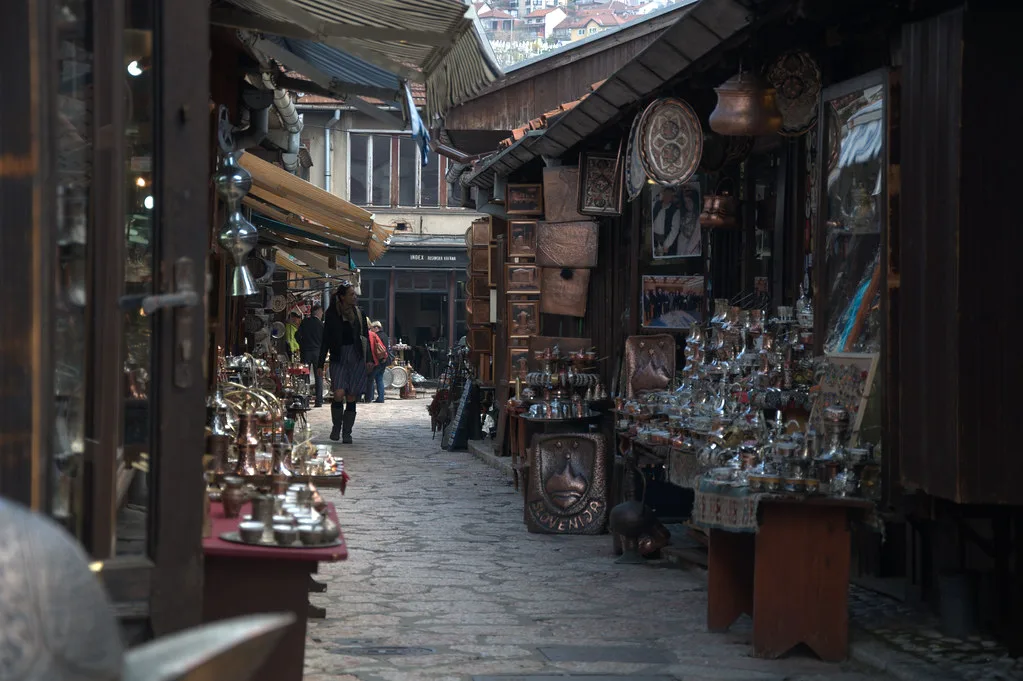
A car buys freedom for the rural half of the country, where bus schedules thin out fast. If your list includes the Una valley, Sutjeska and its lakes, or the mountain roads around Konjic and Jablanica, self-driving turns a logistical puzzle into a straightforward day. Elsewhere it is a liability: old-town streets in Mostar and Sarajevo were not built for parking, and you will pay to leave the car while you walk.
Drive carefully, stick to speed limits even when locals don't, and always take the insurance. Mountain roads reward patience rather than pace, and a late-afternoon arrival in an unfamiliar town is the wrong time to be learning them. Pick up and drop off at the same city unless a one-way fee is clearly worth it.
Taxis in Mostar and Sarajevo
Taxis are cheap and useful for short hops, with an average ride around 3 BAM, roughly $1.50. In Mostar call the local 1503 service; in Sarajevo, Red Taxi is the name to know. There is no Uber or Lyft in the country, so ask your host or a waiter to call one and it will arrive quickly.
Use them for the airport, for luggage-heavy station transfers and for evenings when the trams have stopped. For everything else in the center, walking beats a ride: the old quarters of both cities are compact, and the good views are up stairways that cars can't reach.
Getting to Bosnia and Herzegovina from Croatia, Montenegro and Serbia
Sarajevo Airport handles the main flights, but budget travelers often find cheaper fares into Split and cover the rest overland by coach. Coming from the coast, the usual approach is Split to Mostar, with Dubrovnik afterward. From Dubrovnik or Montenegro, head to Dubrovnik first and travel north to Mostar.
Overland coach travel into Bosnia and Herzegovina from neighboring countries is easy and widely used by backpackers. Build in extra time at borders on the coastal corridor, where you may cross more than once between Split, Neum and Dubrovnik. Check entry rules on your own government's official page before booking, since the requirements depend on your nationality rather than on the route.
Reaching the headline sights: Mostar, Blagaj Tekke, Pocitelj, Kravica, Konjic, Visegrad and Srebrenica
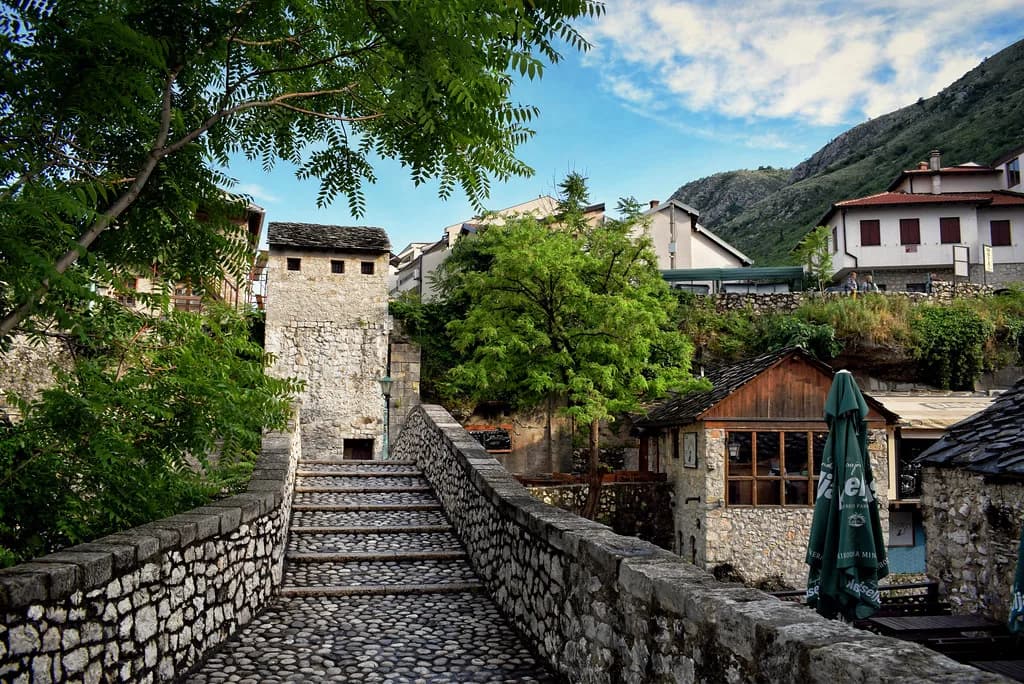
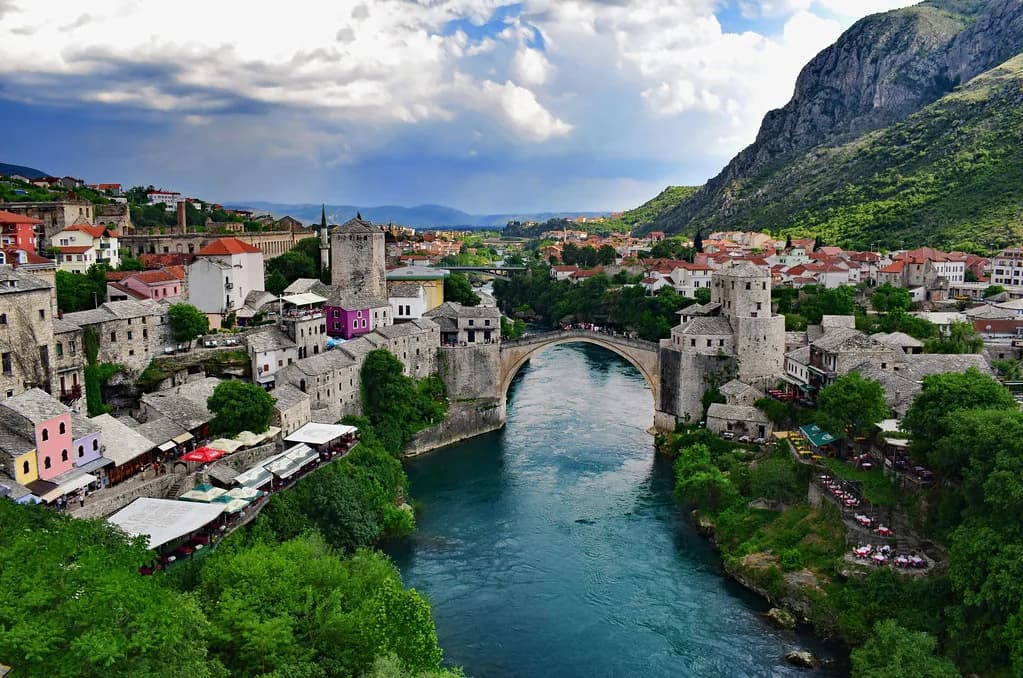
Stari Most in Mostar and the Ottoman bridge at Visegrad are both UNESCO World Heritage sites, and both are walkable from their town centers once you arrive by coach or train. Allow a full day for Mostar itself, including the war museum and a swim in the river below the bridge in warm months.
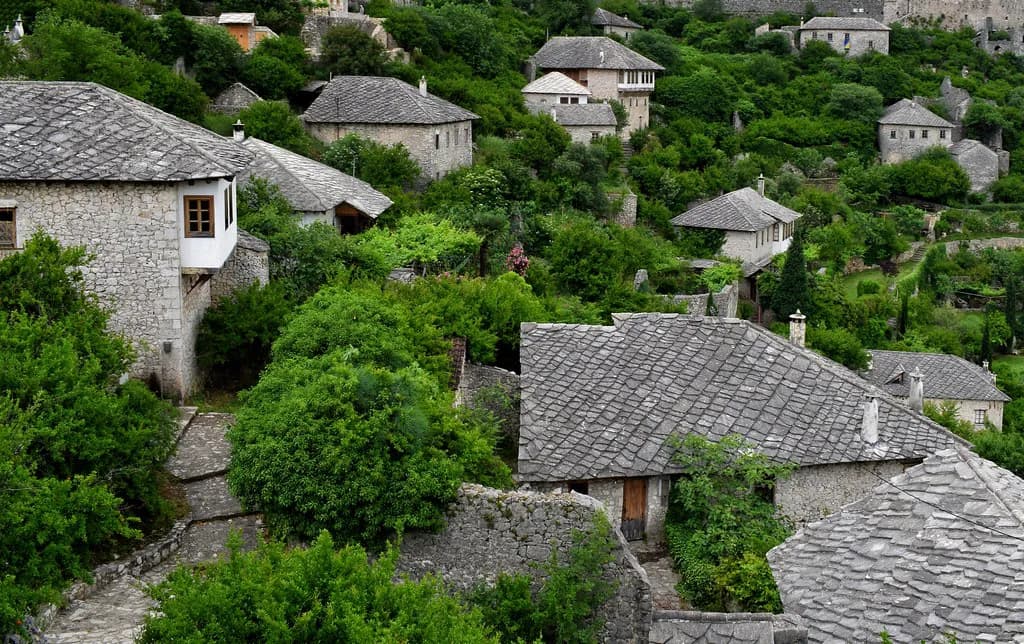
Blagaj Tekke, the Sufi monastery built into the cliff, sits close enough to Mostar for an easy half-day and a coffee by the river; Pocitelj, with its fortress walk, works as a stop rather than an overnight. Kravica waterfalls are the natural pair with Mostar, but they are hard to reach on public transport, making a tour or a car the realistic route.
Konjic is the base for hiking and rafting, and it rewards at least one night if the outdoors is your reason for coming. Visegrad and Srebrenica sit in the east, where services are thinner and cross-region connections are least reliable. For Srebrenica, join an organized tour so the memorial and its context are handled properly, and for Visegrad plan the bridge and old town around a single daily coach in each direction.
How many days you need, transport factored in
A week is the minimum for Sarajevo, Mostar and a day trip without feeling rushed; ten days lets you add Konjic or the eastern towns. Two nights per base is workable only when the transport between them is short, and several of the legs here are not. Three nights in Mostar, for example, gives you one day for the old town, one for Blagaj and Pocitelj, and one for Kravica.
If you rely on public transport, cut one base rather than one day. Two well-connected towns explored properly beat four reached through dawn departures. Where a single daily coach links two stops on your list, either accept the lost day or drop the stop; those are the only two options that keep a short trip pleasant.
Typical costs for moving around
Rail is the value leader on the Sarajevo–Mostar corridor at 16.90 BAM one way, and the airport bus into Sarajevo is 5 BAM. Add the 1 BAM station tax to every coach departure, and budget roughly double the train fare if you take the bus between the two main cities. Short taxi hops average around 3 BAM.
Car hire rates, fuel and parking vary by season and supplier, so compare quotes for your exact dates rather than relying on a general figure. Factor in the cost of leaving the car outside old towns, where you will walk anyway. Tours to Kravica or Blagaj often undercut a day's rental once fuel and parking are counted.
Common mistakes in planning Bosnia transport
The most common error is treating map distances as travel times. Mountain roads and sparse timetables stretch a short hop into half a day. The second is assuming a rail alternative exists for every route; outside the Sarajevo–Mostar line, plan on coaches.
The third is booking a rural highlight without arranging the last leg: Kravica and Pocitelj are the usual casualties. The fourth is buying a bus ticket online and discovering it needs printing. Keep the itinerary modest, and the country's slow transport becomes part of the trip rather than a problem to solve.
Verdict by traveler type
If you have four or five days and want Sarajevo, Mostar and one waterfall day, skip the car: train down, bus or tour for the rural stop, taxi to the airport. Budget travelers and solo travelers get the best value from coaches and the railway, and the low taxi fares cover the gaps.
If you have a week or more and want the Una valley or Sutjeska, rent a car for the rural middle of the trip and hand it back before the city days. Families and small groups usually come out ahead that way once tickets multiply. Anyone planning the eastern towns should accept fewer stops and more slack. Wherever you sit, the decision is about which sights matter most; our Bosnia verdict sets the wider case for the trip itself. If you are already weighing a short hop across the border, our Kotor verdict applies the same logic to a nearby base.
Plan Your Trip
Book the Sarajevo–Mostar train for the day it fits, buy coach tickets at the station with cash for the tax, and reserve a car only for the rural stretch. That plan keeps costs low, keeps the scenery, and leaves room for the delays that mountain roads and sparse timetables will inevitably add.
If your dates are open, the shoulder months make the transport easier and the towns calmer; the best time to visit Bosnia covers weather and crowds in detail. Whatever you choose, decide the route first and let the transport follow, not the other way round.
Explore more Bosnia and Herzegovina trip-decision guides
Frequently Asked Questions
Do you need a car to get around Bosnia and Herzegovina?
No for a Sarajevo and Mostar trip, yes for the rural sights. The two main cities are linked by a twice-daily train and by more frequent coaches, and day tours from Mostar cover Blagaj Tekke, Pocitelj and the Kravica waterfalls without a vehicle. A rental car earns its keep when your list runs to the Una valley, Sutjeska or mountain roads where buses are few, and it becomes a nuisance in old-town Mostar and Sarajevo, where parking is scarce.
Is the train or the bus better between Sarajevo and Mostar?
The train. It runs twice daily in each direction, takes about two hours, and costs less than half the bus fare; buses are more frequent but take an hour or more longer. Sit on the right side leaving Mostar and the left side leaving Sarajevo for the canyon views. Buy rail tickets at the station on the day, which is simpler than booking ahead.
How do you get from Sarajevo Airport to the city centre?
The 200E bus runs roughly hourly on most days, takes 40 minutes to an hour into the centre, and is paid in cash on board. The timetable is posted at the stop outside the terminal. A taxi is faster for a late arrival, and rides are short and inexpensive enough that the transfer never becomes a major expense.
How many days do you need in Bosnia and Herzegovina without a car?
Plan on a week for Sarajevo, Mostar and one day trip, and ten days if you want to add Konjic or the eastern towns. Public transport adds real time to each move, so three nights in Mostar makes more sense than two: one day for the old town, one for Blagaj and Pocitelj, and one for Kravica. Drop a base rather than a night when the timetable is tight.
Sources
Trip-decision notes
Optional updates when we publish or revise a destination verdict.
You might also like
Continue reading
More guides you'll find useful